
Batman Dark Patterns is set to become a modern classic for the caped crusader. It is dark and gritty, feeling like a ‘back to basics’ take on Batman. Batman Dark Patterns from DC is anything other than basic though. Dan Watters and Hayden Sherman serve readers a rich and deep look at how Batman is written and perceived. With complex themes and ideas, it is easy to miss some concepts. However, this article will help explain the meanings behind Batman Dark Patterns.
The main themes of the 12 issue series are the opposing ideas of myth and logic. Writers can tend to take Batman in one of these directions, as either a larger than life symbol of Gotham, a legend – think someone like Morrison. Or they stick to the detective angle, where Batman is more like a modern day Sherlock Holmes, where wits rather than fists save the day.
Dark patterns
The frame that holds the story together is this idea of patterns and this is evident from the start. In the opening issue, we are presented with a horrifically tortured body. Dr Sereika, a forensic pathologist, comments about how wound patterns can tell him a story of what happened. Batman also notes that this is the third body found in this state. That is enough to indicate a pattern.
This is the logic of patterns. It can direct you to an outcome or an idea. Take a simple number sequence 1, 2, 4, 7. You might reasonably expect the next number to be 11, having noticed the numbers going up by an additional one each time. Logic was used to solve a pattern.

Of course, patterns can also elicit the opposite idea. Cultures across the world have looked to the heavens and noticed patterns in the stars. Whole myths have been created from the creatures and beings seen in the night sky.
Patterns, and trying to solve them, have a grip on Batman throughout the series. How he approaches them changes as the story progresses. Batman Dark Patterns, at its essence, is a story of Batman’s internal battle to look to evidence to form an opinion or rely on emotion. A case of logic versus myth.
Gotham is on fire
One of the other patterns is throughout the issues is the fires. Gotham is burning. It happens almost right from the start, with the first fire just a few pages into the first issue. It is not until the final arc that the we find out why there are so many fires, but readers will no doubt have picked up on the recurring nature of them.
Batman says in issue 7 that it feels like the fires are trying to burn him out. He creates a mythology about the cause and motive of the fire, with him at the centre of it. Gotham’s fires also present as a metaphor for the fever burning through Burce’s body as he struggles with injuries.
Pareidolia
In Batman Dark Patterns #7 Batman brings up the phenomena of ‘pareidolia’, which is essentially interpreting a meaning from a stimulus. The most commonly known version of this phenomena is seeing faces in everyday things, like a knot in a tree trunk, or a stain on t-shirt. It can extend to all sorts of scenarios like hearing a satanic message in Stairway to Heaven played backwards. This is likely an evolutionary trait that has helped keep us alive, interpreting things quickly.

Batman notes how a detective must see past pareidolia, looking past the patterns to see what is really there. This is a struggle for this Batman throughout and he gets worse at this before he gets better.
The Voice of the Tower
Take for instance The Voice of the Tower arc in issues 4-6, which incidentally is one of the greatest Ventriloquist and Scarface stories. In it, Scarface takes over the residential Bledin tower and Batman is forced to ascend this gauntlet to free a captive cop. Scarface had been in defacto control of the residents, causing them to fight back against Batman and the police, rather than help them get rid of the puppet.
Batman eventually succeeds, with the cop saved and Scarface defeated. Things had been very weird though. The sound travelled very strangely inside the building, causing very disorientating effects on Batman. Even when he destroyed Scarface’s body, that did not stop him as he appeared to then take on the building as a host, his commands still booming around the many floors. Batman even found Wesker, the Ventriloquist, with his tongue removed. So what was going on?
Acousmatic sound
There was a logical explanation to all of this and that is acousmatic sound. Acousmatic is simply where you cannot see the source of the sound. In theory, this can change how you perceive said sounds. While disputed, it is said Pythagoras gave lessons hidden behind a veil so his students could concentrate more on what was being said.

The voice of Scarface, being controlled by a resident called Michelle, was bounced around the tower, and no one could tell where it was coming from. This gave it more credibillity and power among those who heard it.
In Bledin Tower, Batman had a pitstop, talking to a mum and daughter, some of the few not trying to kill him. In an emerald coloured apartment, Batman explains the phenomena of acousmatic sound and the psychological hold it can have. The little girl chips in with how it is just like The Wizard of Oz.
The battle between logic and myth
In The Voice of the Tower, logic seems to win the day, as the cop is rescued and Michelle burns the tower down. Batman figures out this apartment building must have been where Wesker grew up and that he helpd Michelle refine her skills.
Except logic doesn’t quite prevail. As with all good Scarface stories, it is never quite certain that the ventriloquists are in control. Similarly, the residents spoke about hearing other voices – loved ones and former residents. This in itself forms a myth around the building and its community.

There is also the case of the hostage Officer Pryce. She heard the voice of her dead partner guiding herself to safety as the building burned around her. Of course, as Sereika points out, this was clearly just carbon monoxide inhalation from the fire causing audio hallucinations.
This tug of war between reason and mythology is throughout the issues, interwoven into every panel, and by the third storyline, Pareidolia, Batman is moving away from that logical side to the mythological.
The myth of Gotham
After another fire, this time in the Rookery, Batman begins to see a pattern. The Wound Man had been created by a fire and Bledin Towers had also burned down. Batman goes to investigate, finding a body, terribly burned, stuffed in a washing machine. Sereika points that fire is very good at erasing forensics. Fire can remove evidence of what might have happened to a body, making it difficult to understand how someone may have died or when.
It is at the point in the story, we need to start thinking of fire as representative of the myth – the myth of Gotham. There is a story in Batman Dark Patterns #10 about how fire was part of the origin of Gotham. Settlers used it as a way of protecting themselves from the horrors of the night. Fire was a fundamental part of Gotham’s history, with two great fires causing extensive rebuilding and changing the physical cityscape.
The Red Hood Gang
While investigating the burned body int he Rookery, injuries and stress edge Batman towards a conclusion. Alfred thinks the modus operandi seems similar to an old outfit, the Red Hood Gang. The gang used to shove people’s heads into buckets of bleach. Sereika’s evidence confirms this body had been exposed to acid, prior to being set alight. Using this, Batman go after the gang, trying to find anyone to talk to him in the Rookery.
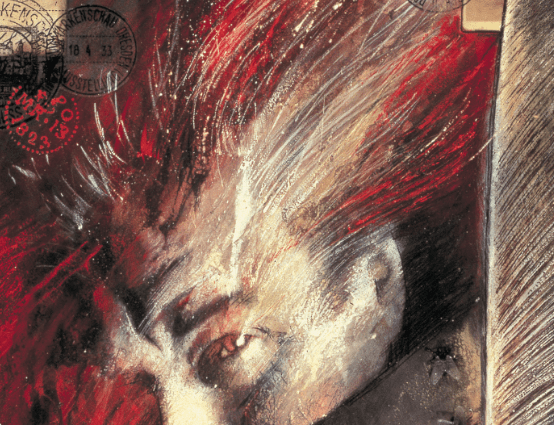
Sherman’s wonderful image of Batman screaming into the night sky, silhouettes staring down at him from blocks in the Rookery, plays into the themes of the series. It invokes a man against the world or perhaps, a paranoia. Batman finds a pattern that doesn’t lead to the answer.

An unshaven, tired Batman terrorises the rookery for a week, looking for someone to talk about the gang but turns up nothing. That is, until he chases two boys who had been watching him into a yard. Batman finds a coffin, before he is promptly shot from a window and taken prisoner.
The perpetrator, an old man, with support from the two lads were the Red Hood Gang. Kind of. The old man had lied to the two boys, saying he had been in the gang when he was young. He claimed the body was of a former girlfriend who had also been seeing a cop. None of this was true though.
Magical thinking
The trio dug up a corpse and put its head in bleach, afterwards setting a fire to draw attention to the body. The reasoning? They thought that people would behave better if they knew the Red Hood Gang was back, bringing the ‘good old days’ back to the Rookery. The old man had mythologised his own past to try and bring this about.
The resulting revelation of this ended in tragedy. A child was shot and the old man had a heart attack. As he was still tied up, Batman was unable to stop any of this.
At the beginning of issue 9, Batman had realised he had been doing magical thinking, patrolling the Rookery, thinking he was more than just flesh and blood. Batman was guily of confirmation bias. Batman thought it must be the Red Hood Gang and, after hearing there was acid involved, that confirmed his suspicions.
In reality, it could have been coincidence, a copy-cat style, or any number of other reasons. Batman does not stop to think, instead seeing that pattern there that fit his belief at the time. It was only when he was aware of his own magical thinking that he could take a step back and work out what had really gone on.
Nicky Harris
There is one key character not yet mentioned and that is Nicky Harris. Nicky is a journalist who had a loose relationship with Batman having helped him on a previous case. Harris wrote sensationalist articles. Nicky is immediately involved in this myth theme saying ‘this city was built on a foundation of myth’ and ‘we cling to old stories from our old lands, they make more sense than life in Gotham.’
Interestingly, Harris suggests to Batman that Sereika had been leading him astray with the Red Hood Gang case. He tells Batman how Sereika dabbled with drugs and was fired from the body farm after burning it down, thinking the corpses were talking to him. This is a myth.
The Child of Fire
The big twist of the series is of course that Nicky Harris is much more than a simple journalist with an artistic license. Harris is the man behind the fires, he is the Child of Fire. He was behind the fire that killed the Wound Man’s wife, and had encouraged Michelle to burn down the tower. The Child of Fire also committed other murders, attempted murders, and arson.

The Child of Fire’s final plan involved kidnapping Sereika and starting a new Great Fire of Gotham. Like its predecessors, this fire would usher in a new era. Harris believed this would be a mythological one, which would cause Gotham to be rebuilt. For Harris, fire is the source of creation. The suffering Batman though is able to break his fever and save the day, rescuing Sereika and stopping the fire.
The Age of Myth
Harris, in his monologue to Sereika, mentions trying to start a new Age of Myth, and that he can almost touch it. Who should then reach out of the smoke and flames and touch him? Batman! Is this suggestive of Batman being a myth? He walked through those flames without any harm, like he was the fire itself.
Batman himself is split between two worlds, somehow experiencing the present, but also the previous great fire of Gotham. As if somehow he straddles a world of magic. Witnesses even see him turn towards the fire chasing him, only for it to stop in its tracks. All of these point to some other force involved. Was Harris right?
Harris saw Batman as being at the centre of his vision of a new Age of Myth. He actually thought that Gotham had dreamt up Batman. While for Nicky the fire had to consume Batman for his plan to work, Harris saw Batman as a symbol for Gotham and the city, i.e. the people, need to see him this way.
Symbol or policeman?
It is important to remember that Harris had a reason as to why he took Sereika hostage as well. As he hinted to Batman earlier, he felt that Sereika was leading Batman astray. Harris felt that Sereika had turned Batman into a mere policeman. Harris saw Sereika as his opposite.

Despite their search for truth, in their separate methods, Harris felt them ideologically opposed, with Sereika and his logical method. The Child of Fire felt he was fighting for the heart and future of the city. Thus Harris set a fire at the Bank of Gotham with himself and Sereika inside, letting the fire decide which one of them it was going to consume.
Sereika and Harris represent those different sides of Batman too – the mythological and the logical, and this was their role in the story.
The logical conclusion
Batman himself put forwad the logical reasons for his ability to walk through the fire without harm. He said that his lizard brain was set alight (metaphorically of course) with all functions focused on surviving. This gave Batman the hysterical strength to overcome the deadly environment. Similarly, those witnesses who saw him stop the fire were also victim to the same hysteria, no doubt from all the smoke inhalation.
This would look like that Batman took the logical conclusion, rather than the mythical. He accepted a role more like Sereika’s. Incidentally, ‘Sereika’ means to serve. Batman becomes a servant of the city. This is a distinct difference to that of becoming a symbol like Harris believed.
There is a moment where Bruce tells Alfred he is not a child when asked to take his medicine. This is a direct link to Harris in his role of Child of Fire, a role that is led by the fire. Batman is not being led here by patterns, voices, pareidolia etc. He is thinking logically and clearly.
The story ends with the fire accepting a new shape and that is of Batman. How you read this is entirely up to you. Could it be the firey passion for the city, or a burning desire for justice? Or has the fire merged with that cool, logical side to become something new?
Pre-order Batman Dark Patterns – Bookshop.org
Pre-order Batman Dark Patterns – Bookshop.org UK
Pre-order Batman Dark Patterns – Forbidden Planet UK



Leave a Reply