
Marvel has had a few controversial comics but only one has earned intervention from the British Royal family. Peter Milligan’s X-Statix series is the offending title, courtesy of including Princess Diana in the five-part storyline Di Another Day. Or at least he tried to.
Issues 13-18 of X-Statix (illustrated by Mike Allred, colours by Laura Allred) were published from 2003, just six years after the death of Diana in a car crash. Milligan’s story had the spirit of Diana resurrected in a host body, before picked up by the team of fame chasing mutants of X-Statix. It was here that Diana was to learn that she herself was a mutant too, told by none other than Professor X.
Writing in The Guardian, Milligan said he was originally inspired to write Diana as a mutant after experiencing the reverence of the British public after her death. Making dark jokes in the pub after she died, Milligan was met with disgust from his fellow patrons. He saw this as a power Diana was using from beyond the grave, her fame influencing people. Milligan thought she would be the perfect fit for X-Statix.
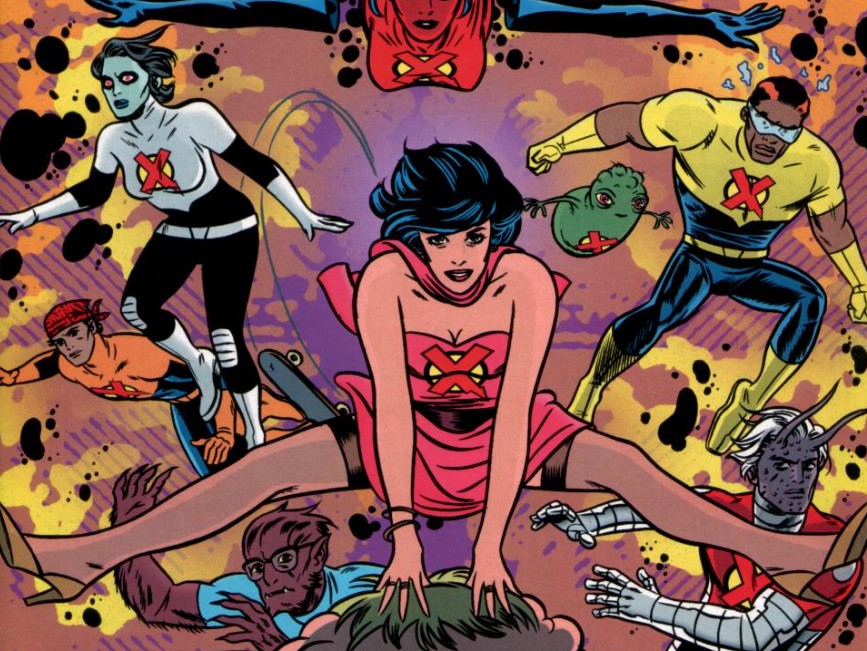
X-Statix are a team of mutants, formed in the pages of X-Force, who were brought together for fame and fortune, rather than Xavier’s vision like the X-Men. Their adventures and acts of heroism were sold to TV stations, making them millions. They were however known for being short-lived, with team members constantly dying throughout the series. It is definitely more tongue-in-cheek than its other ‘X’ series counterparts.
Milligan’s Diana never debuted though as Marvel caved and changed the character’s name, hair colour, and their origin story. Marvel caved because there was a campaign led by the Royal Household and national hate rag the Daily Mail. Thus we end up with brunette Henrietta Hunter.
Poor Henrietta Hunter here was denied her royal titles and instead became a lowly celebrity superstar musician. She had died on stage, electrocuted while performing by a tampered with microphone. This was not the end for Henrietta however.
‘In the world of the X-Men, the mutants are feared and hated. In X-Statix, they have turned this around and made themselves stars, glamorous, rich and powerful. This seems to me to be pretty much what Diana did inside the royal family.’
Peter Milligan writing in The Guardian
In the renamed Back from the Dead storyline, after her resurrection, Henrietta’s time as part of the X-statix team was not a happy one. The team was jealous of how much media attention she got and were particularly aggrieved when she used her popularity to become leader of X-Statix. The likes of the Orphan, Phat, Dead Girl, and the Anarchist plot to kill her, while Trillion-Dollar Man tries to make as much money out of her as possible, no matter how.
For her part, Henrietta used her fame, position on the team, and apparent immortality, to forward things like her charity work, so long as she was front and centre. She even used TV interviews to talk about how she was murdered. Henrietta was not oblivious to the team’s dislike of her though, her self-proclaimed power of empathy picked up on that. This Diana stand-in was a perfect mix of hilariously naive and occasionally downright cunning.
The rest of the series sees us join the team on adventures like facing up to villains like Mister Code and Eurotrash, a team made up of crude stereotypes to appeal to the “American audience”. They even travel to Afghanistan to fight the Taliban (at a time where troops the US, UK and their allies were fighting in Afghanistan) where they discover that Henrietta is quite the cold-blooded killer.

At the same time, the establishment was also trying to kill Henrietta and the arc ends with her confrontation between Henrietta and her original killers. One of them utters a few lines that are reminiscent of how a lot of the British public spoke about Diana’s death.
“She was becoming too popular. Her charities. Her good work, her common touch. It made her powerful. Too powerful. She had to die.”
In the end, despite Marvel’s censorship, a lot of readers would have seen comparisons between Henrietta and Diana. The outrage in the media of Milligan wanting to include Diana in the story no doubt drew more attention to the series than if it had been left alone. Despite the Palace’s fears for the worst, a lot of the story is sympathetic to Henrietta and therefore Diana. Despite the portrayal of her being a bit dim, pampered and manipulative, it was far from being overly negative. With so many trying to get a piece of her, it is hard not to sympathise.
Luckily though, the changes did not detract from the story really. While it was fun to see Henrietta/Diana’s power of immortality pale of comparison to her power of influence, the real interest lay elsewhere. Like in the rest of the series, Milligan has a lot to say on sexuality, mutantism, racism, war, fame, money etc. As a work of satire, it was only natural that it played off real world events and people. On this occasion though, it might have felt a bit too soon.


 Key Comics Vault
Leave a comment