In 1982, Marvel did two groundbreaking things; it released its first graphic novel, a new way of collecting its stories that has proved incredibly popular to this day and secondly, it killed off a superhero permanently. A death of a superhero can be a cultural event, it also can boost sales and drive narratives. Those heroes don’t tend to stay dead for long though. The most obvious example of this would be the death of Superman, which was a huge moment for DC, both in universe and financially in the real world. His death was short-lived though and Superman returned less than a year later.
This was originally published as a video in December 2023. The link is at the bottom if you would prefer to watch.
There have been numerous other examples of this happening both at Marvel and DC; think Captain America, Jean Gray, Jason Todd, Wolverine, the list goes on. Superheroes are DC’s and Marvel’s bread and butter, so keeping them 6-feet under does not help sell comics. Reintroducing them makes financial sense, as it means they can continue publishing that series but it does cheapen that death and audiences are wise to this.
Traditionally the only people who stayed dead are those relevant to a hero’s origin story, like Uncle Ben or Thomas and Martha Wayne. However there is one hero who remains dead and will continue to do so. That is, of course, the original Captain Marvel – Mar-Vell.
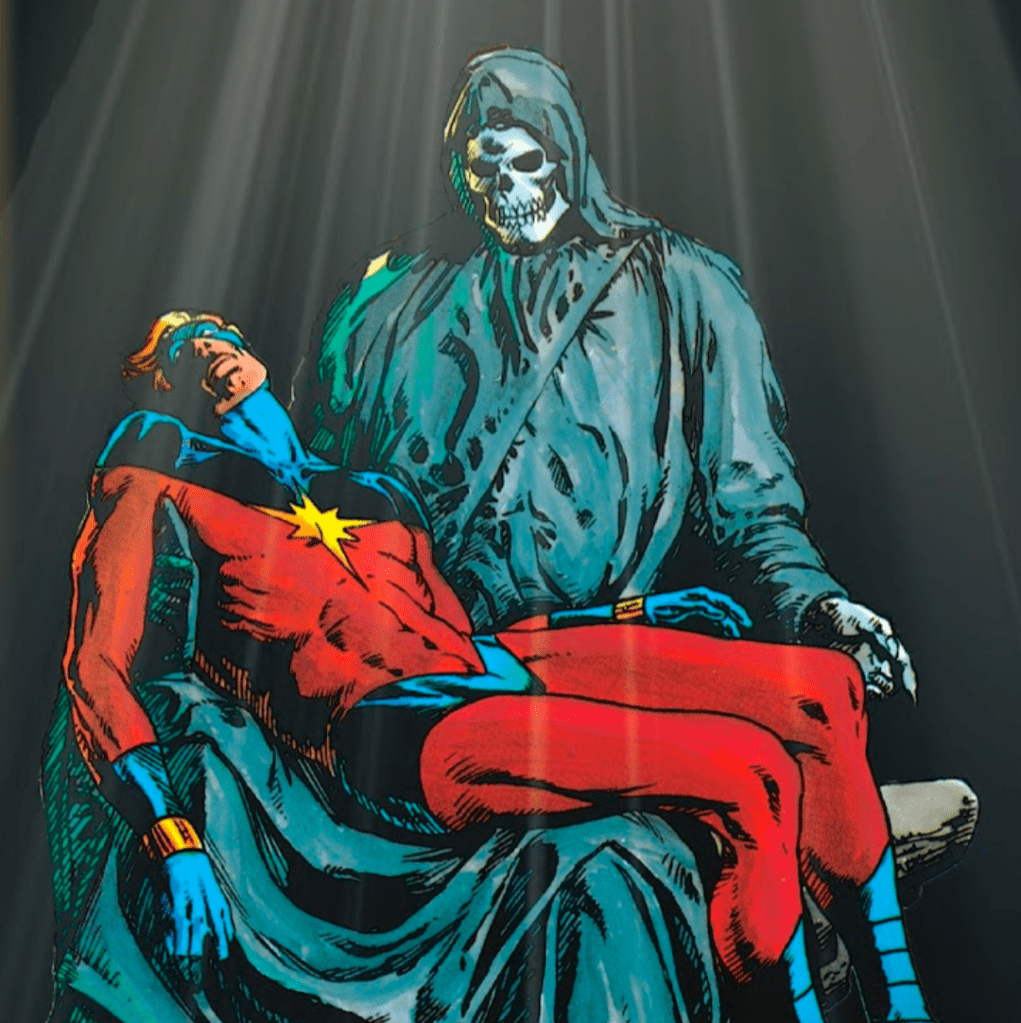
Jim Stalin’s graphic novel, The Death of Captain Marvel, tells the story of Mar-Vell facing down his mortality. Having previously fought Nitro and being exposed to a nerve agent, he discovers he has cancer. As he writes his memoirs and says goodbye to his loved ones, the best and brightest of the superhero community look for a cure. A galaxy-wide search is underway, looking for something that will work with his Kree biology but nothing is found. Surrounded by some of the most powerful, intelligent beings this hero and champion is laid to rest. His chapter is closed in the Marvel Universe.
Except, it was not always closed, as Marvel could not let him rest in peace. Marvel brought Captain Marvel back for Chaos War and in Secret Avengers to take on the Phoenix. In both, Captain Marvel fights the good fight and dies nobly. Both stories are very brief returns to the land of the living, with the Marvel team clearly not intending for him to be alive for anything longer than a couple of issues. This is largely in respect to the original The Death of Captain Marvel story.
Stalin’s work is incredible. Firstly, without concentrating on this aspect, it looks amazing. If you are a fan of old-school sci-fi comics, it is worth reading just for that. Starlin shines in space operas but it is the storyline that is really special. The story manages to humble the entire superhero community. All these incredible beings who have achieved innumerable feats over the ages, cannot help their fellow hero or friend; one struck down by a horrendous, but sadly common, illness. Surely, the likes of Reed Richards and Hank McCoy could dedicate some time to curing cancer, or Alzheimer’s, or any disease? Obviously, this would not make for a thrilling Marvel story, but it is good to challenge these ideas.
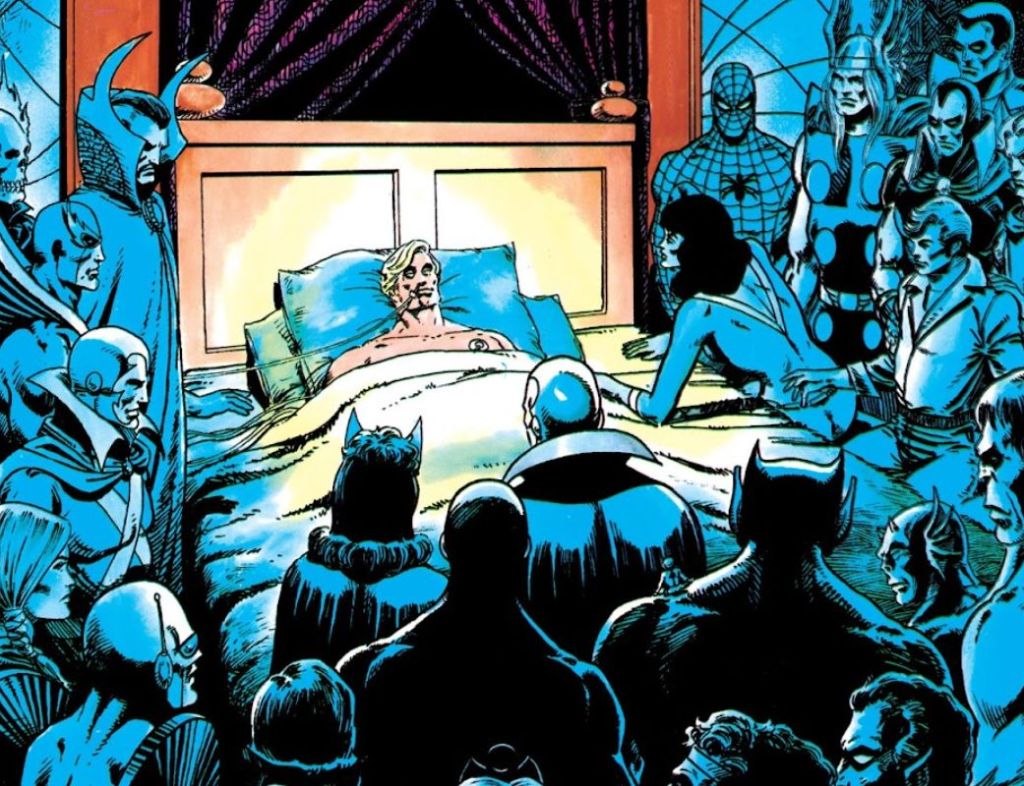
Where the book really delivers is through the emotional intelligence and maturity displayed throughout. As Mar-vell explains his situation to others reactions are unique and so human. Elysius is sad but loving, Spider-Man simply walks away unable to cope, and Rick Jones is furious storming off. People take grief in different ways and unless you have been in this scenario, you might be surprised by those reactions.
Mar-vell himself has very in control over his emotions calm in front of others, but loses that control in private, lashing out physically. Before his rage evolves into simply being at a loss. How can he, Captain Marvel, have survived all those battles to be defeated by this? We are all the main character in our own stories, so it can be difficult to imagine a world without ourselves and Starlin confronts it head on here.
As he falls into a coma, life slipping away, Captain Marvel sees Thanos appear before him. Towering over his frail body, his old foe grants him his strength back so they may battle one more time. This time, in defence of the heart of the universe. Furious is their battle, Mar-vell back to his best, chasing down Thanos across worlds. As the lover of death, Thanos is able to call on other dead enemies of Captain Marvel to join their battle but Mar-vell stands tall. If this is how he has to go then, then he will go as a warrior, fighting until the last.
Mar-vell shatters these enemies and confronts Thanos directly. Like the others, Thanos shatters with a punch as he is but an illusion; an impression of what is left of Thanos on this plane of reality. A hooded woman joins him – Death. Mar-vell changes, understanding there is only one way now. He accepts a gift, the kiss of death. The heart of the universe slows to a stop, beating no more and Mar-vell follows death and Thanos into the next realm.
Whenever there are conversations about the greatest Marvel stories, The Death of Captain Marvel should always be up there. Starlin deftly covers one of the most complex concepts in death on such a humane and personal level, that on reading it, you quickly realize Stalin must have experienced a terrible loss to create such a powerful and moving story. Sadly, this was the case, as Starlin’s father had recently passed away from cancer and Starlin said that writing this was a form of therapy for him. His pain is evident throughout the story. Out of respect for Mar-vell and Starlin’s dad, please let Captain Marvel rest.
Buy The Death of Captain Marvel Gallery Edition [I earn a commission] – UK.Bookshop.org




 Key Comics Vault
Leave a comment