One of the most common questions about Moore’s and Gibbons’s Watchmen is what is the point of the pirate comic? What is the meaning behind the Tales of the Black Freighter?
The first time you read Watchmen, you might find the sudden change from 1980s New York to a pirate ship a bit jarring. This leads to some people skipping over the comic within a comic, but Alan Moore did include it for a reason.
Read on for a deep dive into Watchmen’s pirate comic.
Tales of the Black Freighter plot
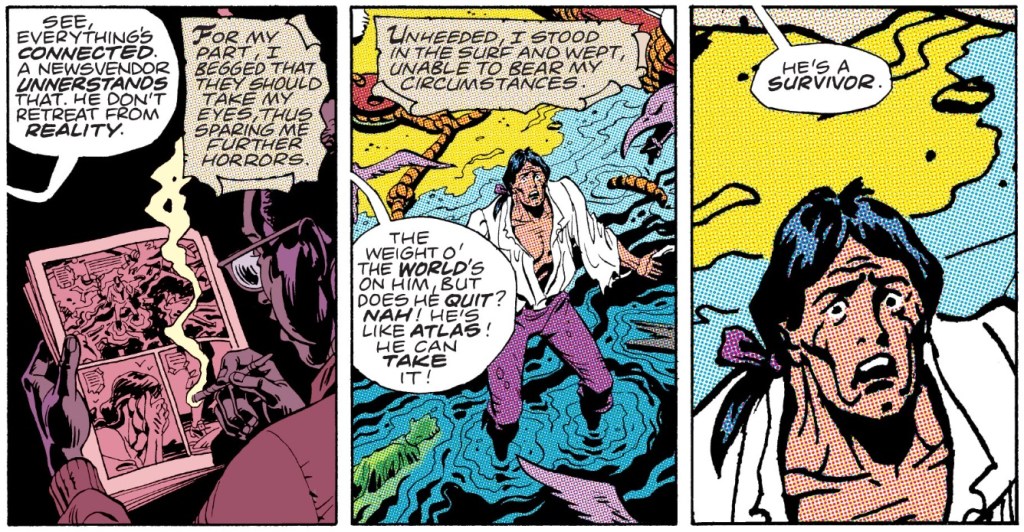
Readers are first introduced to the story of the Black Freighter in Chapter 3, The Judge of all Earth. We see a young man, Bernie, reading a comic at the newsstand belonging to an older man, also called Bernie. Younger Bernie is engrossed in a comic, The Tales of the Black Freighter, ignoring the hustle and bustle of the city around him.
The story begins at sea. A sailor is left adrift when his ship is destroyed by the Black Freighter. The victorious dreadnought ploughs over him, throwing him under the waves. He awakens on an island, marooned and surrounded by dead and rotting crewman. Alone, he sets upon the gruesome task of burying them, all the while thinking that the Black Freighter was heading to his home town, where his family lived; a fate that he believes will see them butchered.
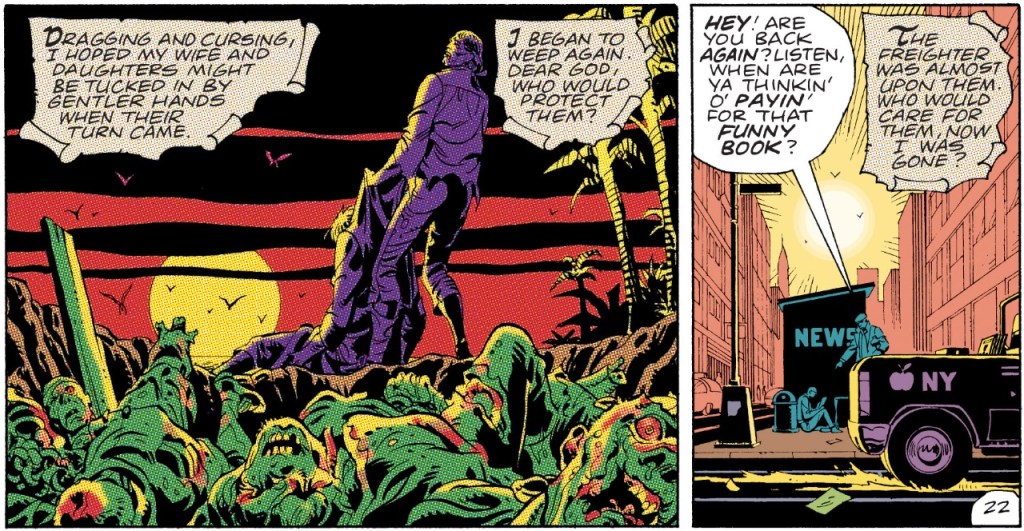
The survivor plans on leaving the island but the wood there is not suitable for building a boat. His mind flits back to his recently buried brethren, many of whom are bloated, filling with gas as they decompose. He fixes the corpses together and sets sail. Attacked by first gulls and then sharks, both attracted by the rotting corpses, he starts to drift. With it drifts his mind. Until it snaps.
Madness creeping in, the sailor starts to talk to the dead shipmates, until he finally reaches land. In his warped state of mind, he decides to kill a couple riding along the beach, reasoning they must have been conspirators with the Black Freighter’s men. Propping up the woman’s corpse on one of the horses, he makes his way to David’s Town.
Reaching his old home, he rushed in to confront the pirates. He attacks a figure in the darkness, before realising it is his wife. His children stand by watching in terror. He flees David’s Town, finding himself back in the beach. The Black Freighter is waiting. It had not sacked the town. Instead it was waiting for him. The only soul they’d ever wanted. He climbs aboard.
That is where the story ends. A tale of one man’s descent into madness and a dark story within another dark story. One that is integral for understanding the series.
History of the comic
One of the most interesting, albeit cursory points, about Tales of the Black Freighter is that it is a part of the Watchmen universe. It is part of the cultural backdrop, adding depth to a world that feels familiar to us, but with some stark contrasts.
The end of issue five has an excerpt from the Treasure Island Treasury of Issues, which examines the series. The panels shown within Watchmen are actually only a handful of those in the series; only parts of issues 23 & 24 are shown of the critically acclaimed series.
In a world where superheroes were real, those types of comics did not reach the levels of popularity that we wouldd recognise, instead tales about pirates became the best sellers. Interestingly, as the government was using superheroes, it did not support any censorship in comics like that seen in the real world from the Comics Authority. That’s why the DC’s Tales of the Black Freighter could showcase such graphic scenes, right from its start in 1960.
The series was illustrated by a number of different artists but it is the writer who is more important for understanding it – Max Shea. Although it is not a name that most readers might remember, Shea crops up a few times in the series. By the ’80s, he is a well known writer, having penned many successful books and comics, with adaptations of his work also reaching the silver screen.
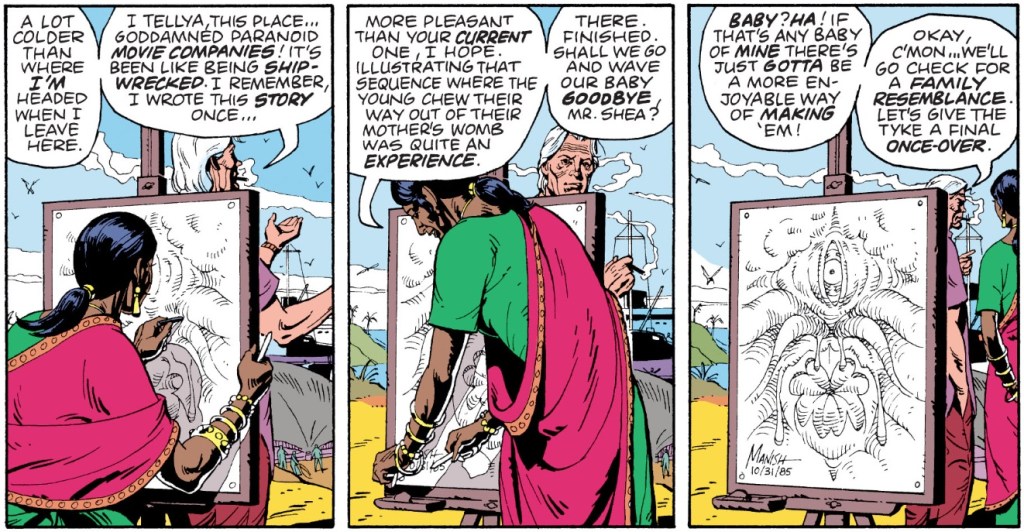
One day though, Shea just vanishes, with police investigations having no leads. In chapter 7, the authorities announce they are closing the investigation. However, as readers we get to see Shea alive, and well talking to an artist, Hira Manish, on an undisclosed island. Manish and Shea were familiar with each other, having worked together in the past. They had both been brought to the island to work on a top secret movie project. This project is of course fake, instead it is a plan by Veidt to get some of the brightest people in the world together.
The project wraps up and the two celebrate in a secluded room on the boat together whilst the others party on the deck. Hira asks whether Max’s marooned character ever escapes off the island as the ship departs. Shea never gets to finish his explanation as he discovers a bomb just before it explodes, killing all aboard.
Shea might have gone on to explain was that man did get off the island but only found damnation; just as all those who worked on Veidt’s project had. Even under the guise of a film project, they were very aware that they were doing some incredibly unethical things. For instance, like using a human brain to create the creature. However, for them the ends justified the means. An approach that is very reminiscent of the actions of the marooned sailor. It is fitting that the doomed author’s life mirrored his work.
The comic mirrors the contemporary world
It is not just the life and death of its author that the Tales of the Black Freighter was mirroring. There are a number of times where life in the Watchmen universe imitates art.
As a visual example, there is a panel where the marooned sailor eats a gull, immediately followed by Nite Owl eating a drumstick on the next page. There is another where the sailor talks to the carving of a woman he had clung onto at sea – “I could not love her as she loved me“. The writing merges with the scene of Laurie and John making love. Dr Manhattan’s withdrawal from humanity and emotions leaves him incapable of matching Laurie’s love for him.
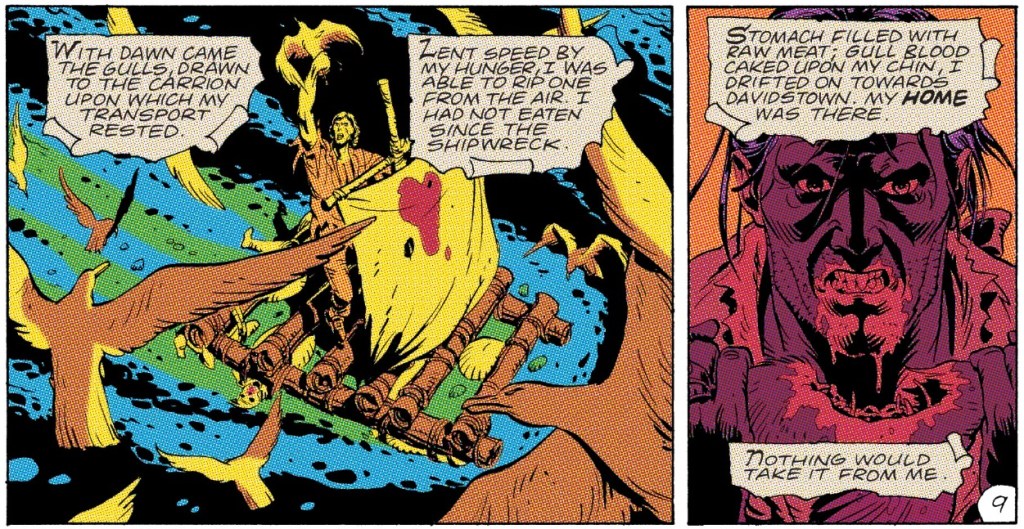
There is also a scene where the cops get a tip off about Rorschach’s whereabouts. Over the phone, the detective mishears it as raw shark. On the previous page, the marooned sailor had been eating chunks of his raft, made from the body of a shark.
These are some of the more obvious occasions, but the series is full of it, where the comics and the real world are in sync. Some examples are easy to overlook on first reading, like Bernie talking about the impending nuclear war saying to watch the financial pages – “those guys are going to make a killing“. At the same time the sailor’s thoughts go to scavengers circling above, hungry. This is great writing, effortlessly blurring the lines between the two stories.

The inclusion of the Tales of the Black Freighter really showcases how Gibbons and Moore worked together so well. Chapter 8, Old Ghosts, demonstrates this best, with the sailor’s monologue placed across panels, the images switching between his world and New York as doomsday approaches.
Ozymandias is the survivor
All of the above adds depth, colour and interest to the story, but it does not really explore why Tales of the Black Freighter is integral to understanding Watchmen. The real explanation of its inclusion is all to do with Adrian Veidt – Ozymandias.
Veidt’s story echoes that of the sailor. In both, we see the decline of a hero, or at least someone we see initially as a hero. The survivor sees himself as on a mission to save his family. Veidt sees himself as on a mission to save the world from nuclear armageddon. Both take extreme measures to see their plans to the end; the survivor kills innocent people to get to his home town, whilst Veidt kills not only the people who worked with him, but millions in New York and, most unforgivably, Bubastis.
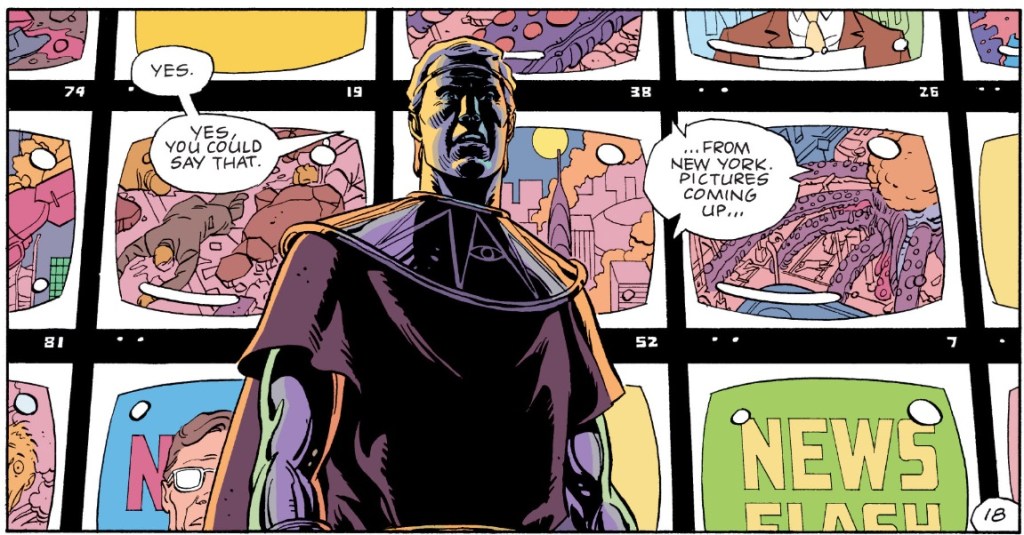
For the survivor, it is a madness that sees himself give in to these barbaric actions. For Veidt, it is a sense of grandeur and his own perceived divinity that leads him to his.
Where their stories differ though is in the ending. The survivor’s story ends with him boarding the Black Freighter, accepting his status as a monster. Veidt’s story essentially ends earlier though, with that realisation or comeuppance not occurring.
Without the Tales of the Black Freighter story, then Watchmen is quite open ended on how Veidt’s actions should be perceived. However, including the Black Freighter makes things quite different. The survivor acts on a fear, the pirates killing his family, that never happens. His actions cause him to murder and eventually lead him to joining the ranks of the damned vessel.
Veidt also acts on a fear; that of nuclear war. Like the murder of the survivor’s family, this has not happened. These similarities would suggest that Veidt too has led himself to damnation and will not be remembered like his heroes Alexander the Great and Rameses II.
Pale Horse
Throughout Watchmen are references to ‘pale horse’, the name of a band. They are popular with the youth group called the Knot Tops, who frequent the series and are responsible for key moments like the murder of Hollis Mason.
The term also refers to the horse ridden by Death in Revelations.
‘And I look, and behold a pale horse, and his name that sat on him was death.’
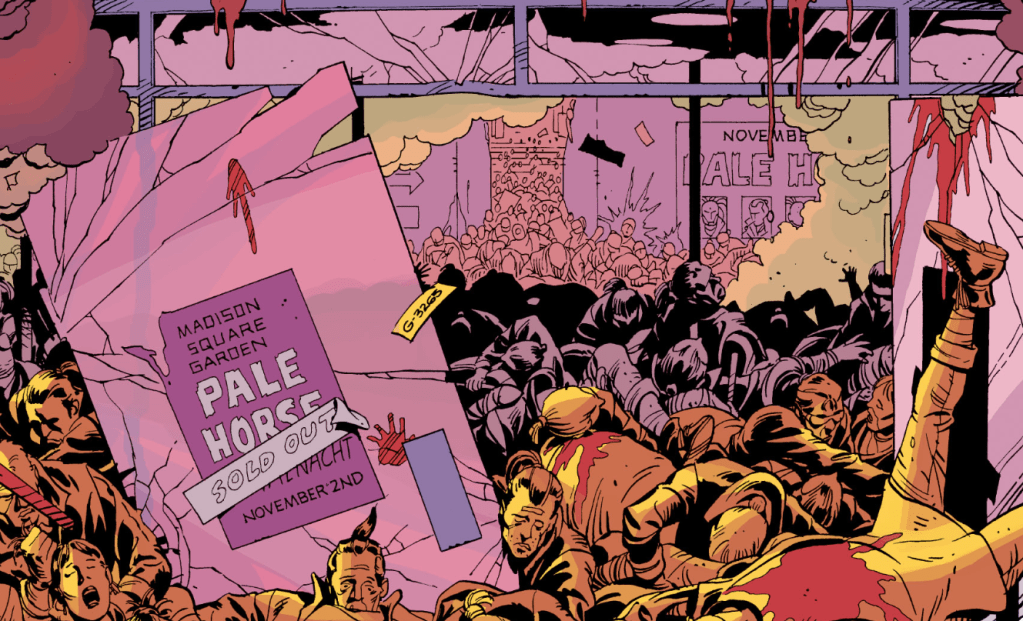
The graffiti and posters continue right up until Veidt’s creature is unleashed on New York. In the aftermath, a sold out concert for the band Pale Horse has become a scene of horrific destruction, with the venue littered with bodies. Death had arrived.
In Tales of the Black Freighter there is another pale creature – the shark who attacks the survivor. The survivor kills the shark and makes him part of the raft. He rides the pale shark as a steed, in his journey to bring death to Davidstown. Just as Veidt brought death to New York.
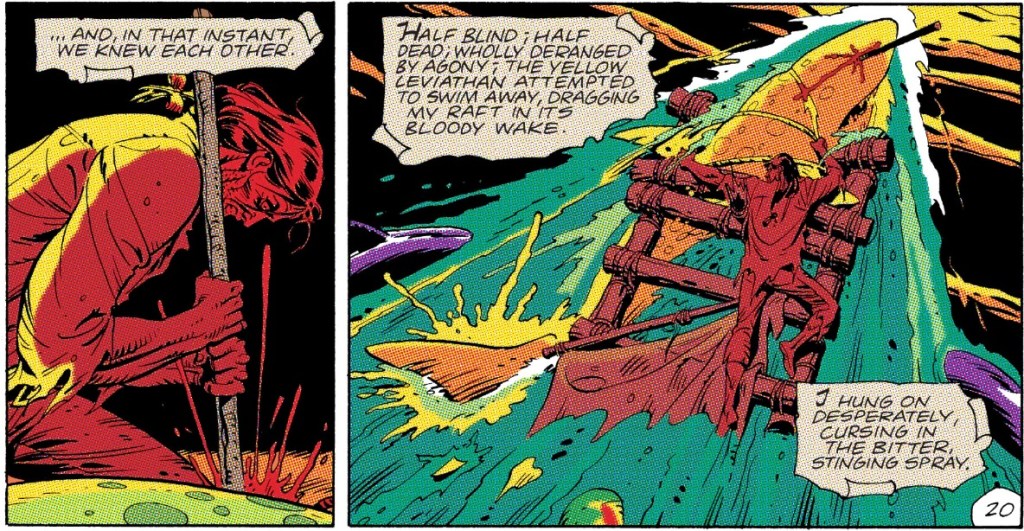
In Veidt’s own words – “I dream, about swimming towards a hideous..” something. He also says that he’s “struggled on the backs of murdered innocents“. It can only be surmised then, that hideous something is the Black Freighter and that struggling on the backs of innocents sounds very much like a raft made of rotting corpses. Veidt is looking through the eyes of the survivor, perhaps on his journey to realising the monster he has become.
Without the Tales of the Black Freighter, Moore’s judgment on Veidt’s actions would be debatable. With it though, it is clear that Veidt and his actions are not to be lauded.
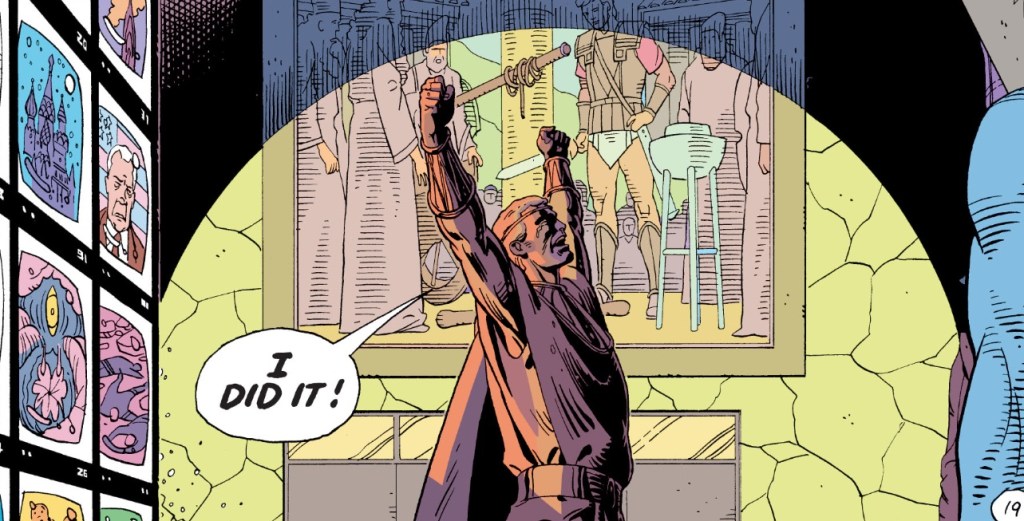
In the final panel, Rorschach’s journal is potentially about to be read and the world explosed to its content. Would that begin the downfall of Ozymandias? Would it make him one of the crew on the Black Freighter? Would it bring war and destruction to the world? Violence only brings more death and destruction.
Buy Watchmen [I earn a commission] – Forbidden Planet UK, UK.Bookshop.org

 Key Comics Vault
Leave a comment