This was originally posted as a video in May 2024. If you would prefer to watch it, the link is at the bottom.
Alan Moore’s and Dave Gibbons’s Watchmen is full of symbolism and metaphors. You can see it through the artwork and writing, hidden in panels and speech bubbles; it is everywhere. One of the recurring motifs is that of the Gordian Knot.
The Gordian Knot refers to an Ancient Greek legend about Alexander the Great – the king of Macedon who forged a great empire through conquest.
The most famous version of this legend says that Alexander the Great was confronted with a problem and an opportunity in Phrygia, a province of Persia. There lay an ox cart tied with a mass of knots. An oracle prophesied that the person who could undo them would be declared king of Asia. Instead of trying to loosen the knots, Alexander used a sword to simply cut through them, using brute force to solve the problem. He went on to conquer large parts of Asia, fulfilling the prophecy.
So, what’s this got to do with Watchmen? And the short answer is… A lot.
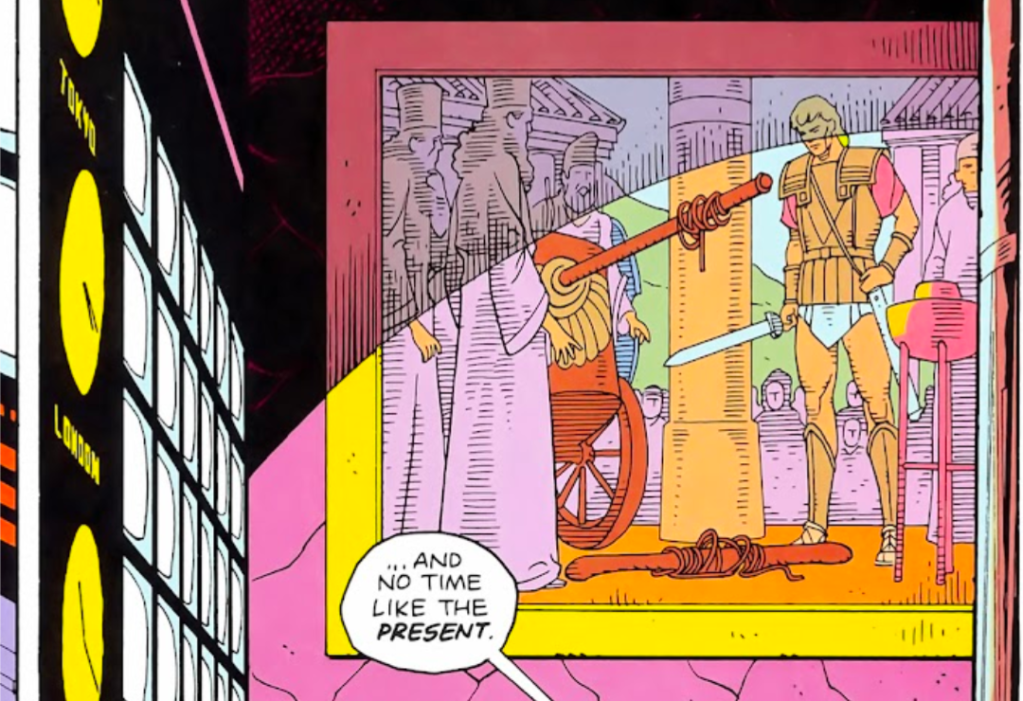
You see, there are a lot of similarities between Ozymandias and Alexander the Great. In Karnak, Veidt’s polar lair, there is a giant painting in the background, showing Alexander the Great cutting the knot. This is shown in the story’s final act, as his plan starts to come to fruition. It is here that Veidt explains his admiration for Alexander, for having a vision and striving to achieve it, even at the cost of innocent lives. He even takes a spiritual voyage to follow in Alexander’s footsteps, visiting places of conquest.
If you cast your minds back to chapter two, we see that Adrian believes the world’s problems as solvable, just requiring a bit of intelligence. Veidt thinks he can be the one to save the world. He thinks that Alexander’s mission was incomplete, as he failed to unite the whole planet, which in Ozymandias’s time is currently at a nuclear standoff. Veidt wants his sword stroke to build a lasting unity.
That world view is again echoed in chapter 10, in an introduction to the Veidt method course. Through it, he claims you can take control by flexing the muscles of the will common to us all, affecting our environment positively. Of course, Adrian isn’t doing this in some purely utilitarian act. He intends to profit, investing in things like baby food, to grow and secure his empire, thus ensuring that he will be the one on top once it ends.
Veidt is overtly trying to emulate Alexander the Great, acutely aware of the parable between his own story and the legend of the Gordian Knot. However, he is not the only one with strong links to the knot. Enter Rorschach.
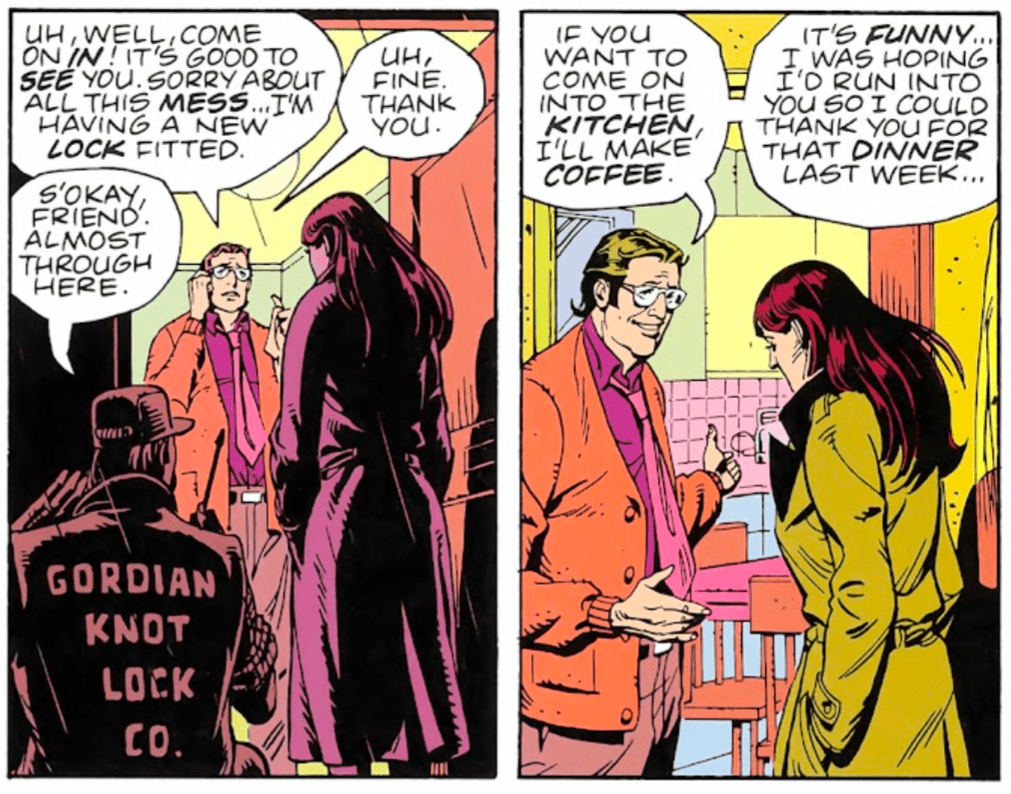
Rorschach is confronted by his own knots a few times in the series. After breaking into Dan’s apartment, Nite Owl has new locks installed by the Gordian Lock Company, only for Rorschach to break in again. Rorschach does the same again to Moloch’s door, again a Gordian lock, forcing his way into confront him.
Rorschach admits to being a fan of Truman whilst in a Charlton home for children. Truman had dropped the bombs on Japan, forcing their surrender and theoretically saving millions of lives. This was in essence a sword through a Gordian Knot, using force to solve what seemed unsolvable.
Whilst Ozymandias was confronting big problems, Rorschach’s were much smaller. Veidt was trying to establish world peace, whilst Rorschach merely wanted to get the other side of the door. They are both comic book heroes though and, generally, all problems are solved through punching the baddy in the face – a black and white solution. To them, force shapes the environment to what they want and in that respect they are very similar, mirroring each other.
Where they differ is that Veidt after a career fighting crime, recognises the problems aren’t black and white. Rorschach however maintains that world view, but they both still apply that use of force to solve the problems.
And just as an aside, Rorschach creates his own knots as well, not just breaking them. Whilst in prison, he ties another inmate’s hands together through the bars, causing Figure to have to use force to get at him.
There are lots of other references to Gordian Knots too. In chapter 9, Dr. Manhattan invites Laurie to look at the Nodus Gordii mountains, Latin for Gordian Knot mountains. There’s also a knot in the wire of a reporter’s mic, as Dr Manhattan faces problems he does not know how to address, although Gibbons said he could not resist adding one there.
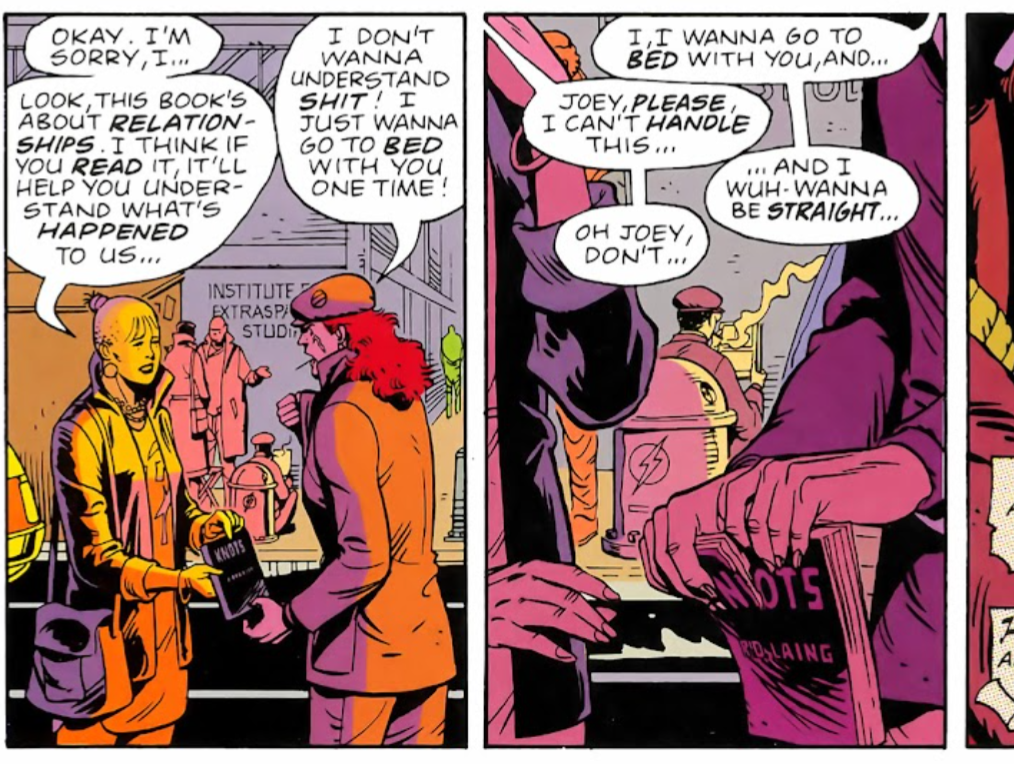
Then there is Joey. Joey and her girlfriend, a member of the top knot youth group, are arguing about their relationship. Joey’s girlfriend suggests a book that Joey could read to help understand what went wrong – a book called Knots. Joey rips the book in half, showing that not everything can be solved with violence. In fact, in what seems like foreshadowing, Joey starts to beat up her girlfriend and people start to get involved in the conflict. A small act of violence, in this case the ripping of the book, escalates the situation rather than solving any problem. How will the world react to Veidt’s actions when Rorschach’s journal is published?
And this is the big conundrum of the whole series. How much force is acceptable to break a knot in two? In a world beset by the threat of nuclear war, one in which the story was written, these were the moral tests of the time. For many, Bernie the newsstand guys stance made sense – ‘we need to kill theirs before they kill ours’. Is collateral damage worth peace though? And for how long?
To borrow a line from Hollis Mason’s Under the Hood: ‘life is messy, inconsistent and it’s seldom when anything ever really gets resolved.’
Buy Watchmen [I earn a commission] – Forbidden Planet UK, UK.Bookshop.org

 Key Comics Vault
Leave a comment