Fun onomatopoeias are ubiquitous in comics and are the method for expressing sound, as they are the most recognisable and simplest to understand. It is easy to forget though, that they are not the only way of visualising sound and Jason Lutes’s Berlin has some fantastic examples of this. Berlin might seem a weird choice on the face of it but Jason Lutes does some really interesting things with this work to create sound.
If you are unfamiliar with the work, and therefore why it’s an unusual choice for such a subject, it is because there is so much else to explore in it. Berlin covers the Weimar Republic, a period for Germany stuck between both World Wars, but one that had huge ramifications for the world as it saw the rise of the Nazis. Rallies and fights in the streets between communists and fascist brown shirts were common, as Germany swayed from possible future to possible future. At the same time, Berlin was becoming the gay capital of the world, and the story showcases the fluidity of both sexuality and gender, that were celebrated in sole corners of the city with a tenuous freedom.
The rich were able to enjoy the exciting world of the roaring twenties with jazz musicians travelling over the Atlantic to play in clubs. In contrast, thousands struggled to keep themselves fed and clothed. Berlin was a melting pot of contrasts, about to boil over with devastating results. Berlin the graphic novel manages to capture this in all its glory – a dense novel, packed with sympathetic characters and snapshots of history. The black and white artwork representative of the contrast seen in the lives of its inhabitants.
Lutes worked hard to ensure an accurate display of the city and time, including how it sounded. The noise of a city making history. The series is filled with lots of city vistas and street scenes throughout. In these scenes, readers may automatically fill in some of those sounds and noises unconsciously, like the sound of a crowded street. This is a natural part of reading comics but Lutes’ artwork brings the panels to life.
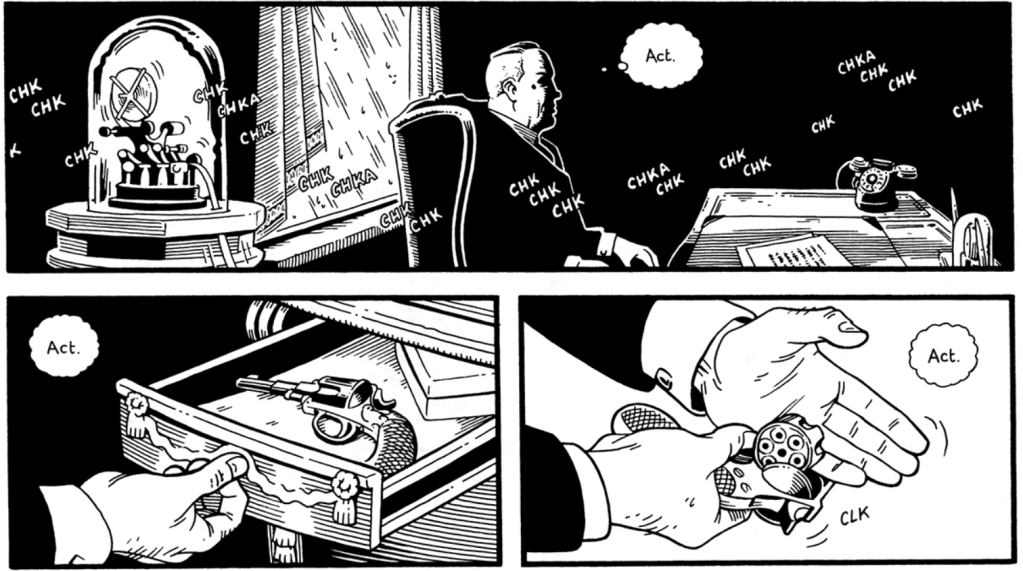
Throughout the series you will find the traditional comic book method of the aforementioned onomatopoetic phrases like the ‘Ch Ch Ch’ of the train chugging along as severing and Marthe arrive into Berlin. Or the ‘pak’s and ‘pok’s of the police opening fire on unarmed communists. These phrases litter the story, perhaps even more liberally than in traditional comics. Size represents volume, a small ‘psh’ for Margerethe’s coffee dregs splashing across Severing’s face followed by a bigger ‘slap’ as her hand makes contact.
Although liberally used, Lutes does not show every sound possible sound, instead using them to enhance his storytelling. The ‘chk chk chk’ of a ticker tape machine makes an appropriate stand-in for a clock, ticking down the seconds before a man shoots himself.
Almost every comic book uses different styles of lettering to emphasise how different words might be said and lutes is the same using bold or italics to highlight how a character is speaking. Lutes goes a step further with sentence case dialogue for normal volume and UPPER CASE FOR YELLED WORDS.
Perhaps nothing innovative so far, but Lutes uses these methods so deftly. Take the scene where Marthe and Severing are having breakfast at at cafe. A tiny ‘crack’ and ‘plp’ as the egg is broken and contents dropped into a cup. The pair talk as Marthe mixes her egg together with salt and pepper – the spoon making a gentle ‘ting ting’. Suddenly a huge ‘kunk shocks the characters and us, withdrawing us backwards to a wider view. All of us had been so engrossed with the breakfast arrangement, and the characters’ terse conversation, that it takes a loud ‘KUNK’ to snap us out of it. It had been sound that drew us in the first place too, adding the audio element in our imagination.
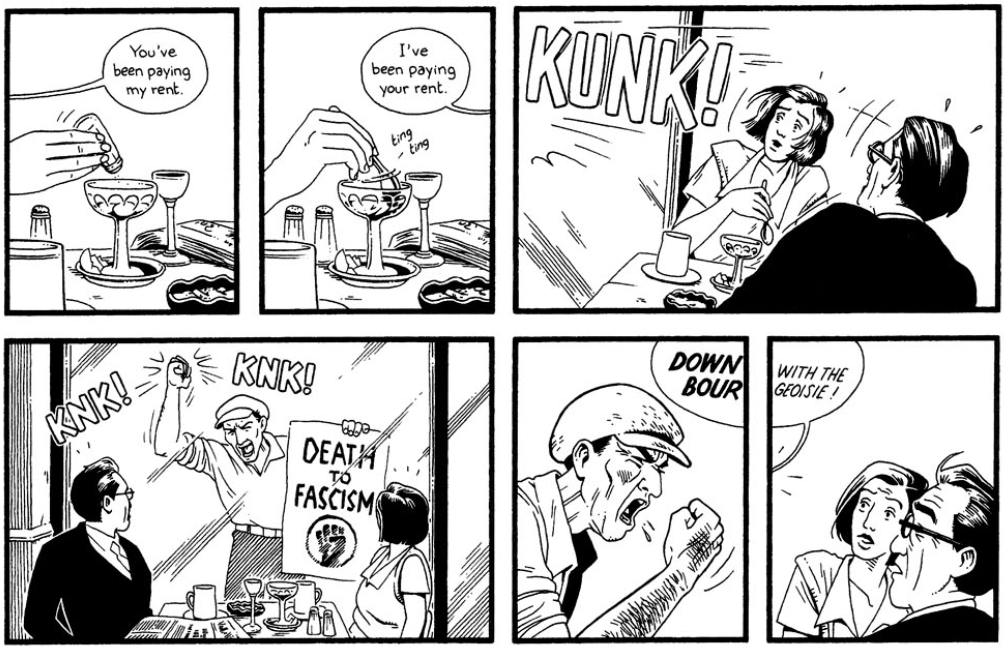
We see that a communist was banging on the window brandishing a placard. Lutes then cleverly uses the guttering between the panels to act as a window, with both panels acted out simultaneously rather than sequentially. The scream of “down with the bourgeoisie” is split with the diners hearing a quieter, more muted version courtesy of the glass with the bold indicating the much louder volume out in the street.
As depicted in that scene, Berlin was fragmented. Whilst some fought for bread and shelter, others got to enjoy a more luxurious lifestyle. The late 1920s in Berlin was exciting if you knew the right people and hung out in the coolest bars. You could get to experience the exciting new sound of jazz, making its way from the States.

No notes or sounds are explicitly shown here, just the movement of the clarinettist Kid Hogan is enough to get the reader filling in the blanks in their mind. Lutes is confident enough in the reader’s imagination to them there.
And there’s another little trick Lutes does, the absence of dialogue. Take this interaction between Marthe and Severing again, but this time with Margarethe at her house. Our attention is divided between the three of them equally as their conversation starts to get heated but after one comment, things change dramatically. Margarethe mentions she’s having a fundraiser for Hitler and our view changes. Suddenly we’re in Severings shoes, wearing his shock and horror.
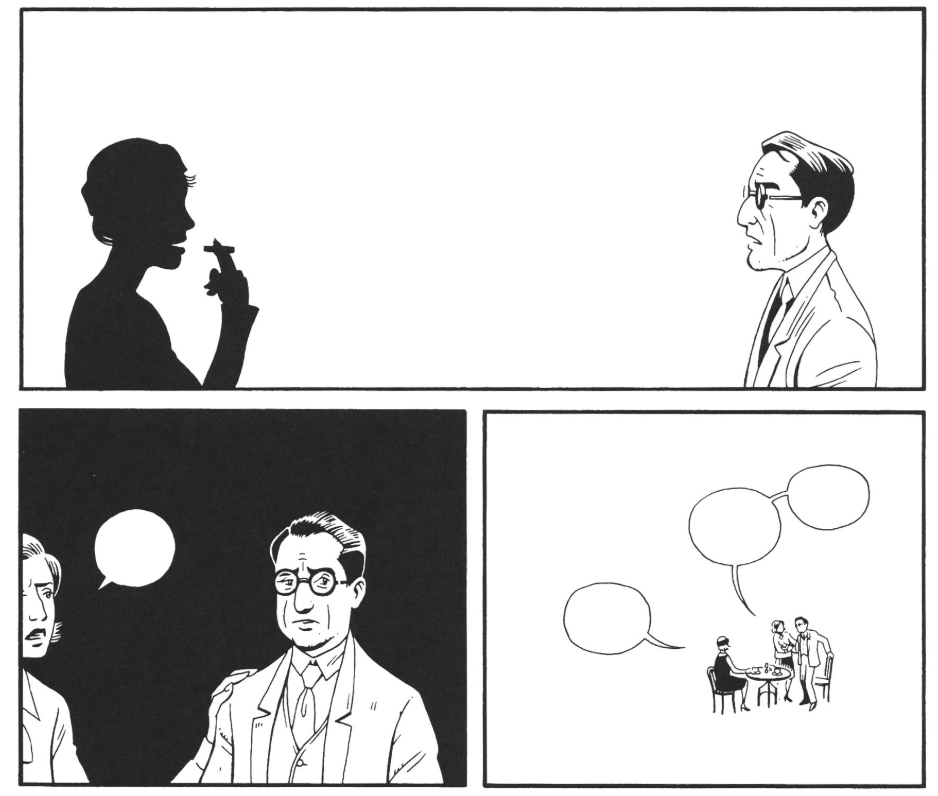
How does Lutes do this? Simply by removing Marthe’s and Margarethe’s dialogue from their speech bubbles. For a book that does not focus on a single character, Lutes deftly gets us be Severing for a page. He is so taken aback that he cannot hear anything else being said. He has to process it. All other matters put to the side as he’s lost in his own thoughts.
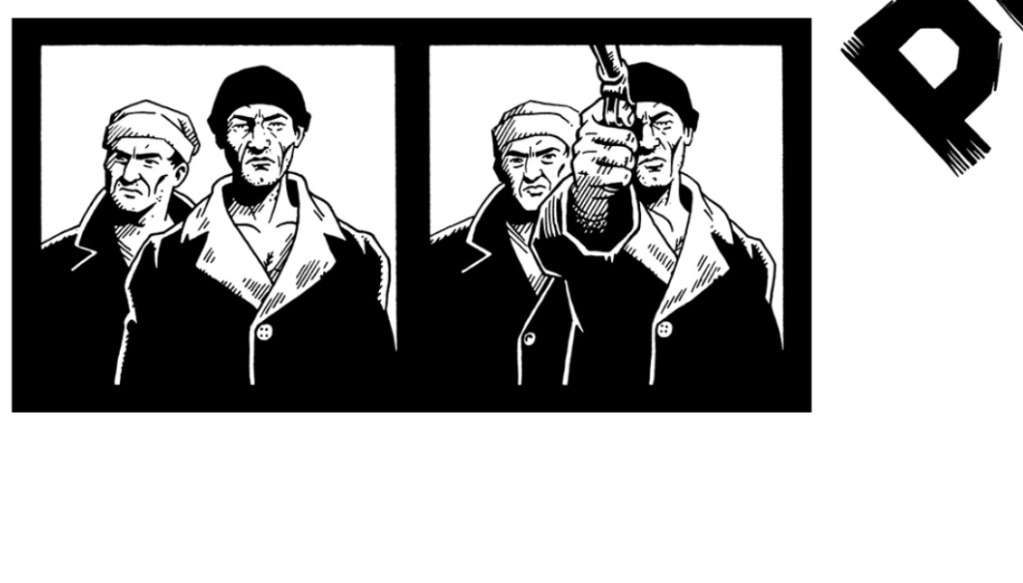
Again, let’s see if we can see where Lutes combines some of these tricks. If we travel to the apartment of Horst Wessel, a Nazi lowlife. He argues with his girlfriend and we see this escalate in the dialogue as bold, capital letters are hurled at each other. Suddenly, just as Marthe and Severing were, they are interrupted by a loud noise as someone is knocking at the door. We’re forced into Wessel’s perspective. Two figures stand waiting, with one raising his hand – a gun. A severed capital ‘P’ escapes the page as Wessel hears the last thing he will ever hear, before nothingness.
You can watch this essay online too!




 Key Comics Vault
Leave a comment