Heroes in Crisis is DC’s crisis event that ignores existential threats, instead focussing inwards and looking at crises of the mind. Combine it with a murder mystery and you have a recipe for a really interesting story. So why does Tom King’s Heroes in Crisis not live up to its own premise and miss the mark?
The story starts with numerous dead heroes, including Arsenal, Flash, and Blue Jay, found at Sanctuary, the secret facility offering heroes support with mental health. As readers, we join Superman, Batman, and Wonder Woman in trying to figure out who is the murderer, while Harley Quinn and Booster Gold have conflicting memories of what happened. Both think the other has done, coming to blows in an attempt to get to the truth of the matter.
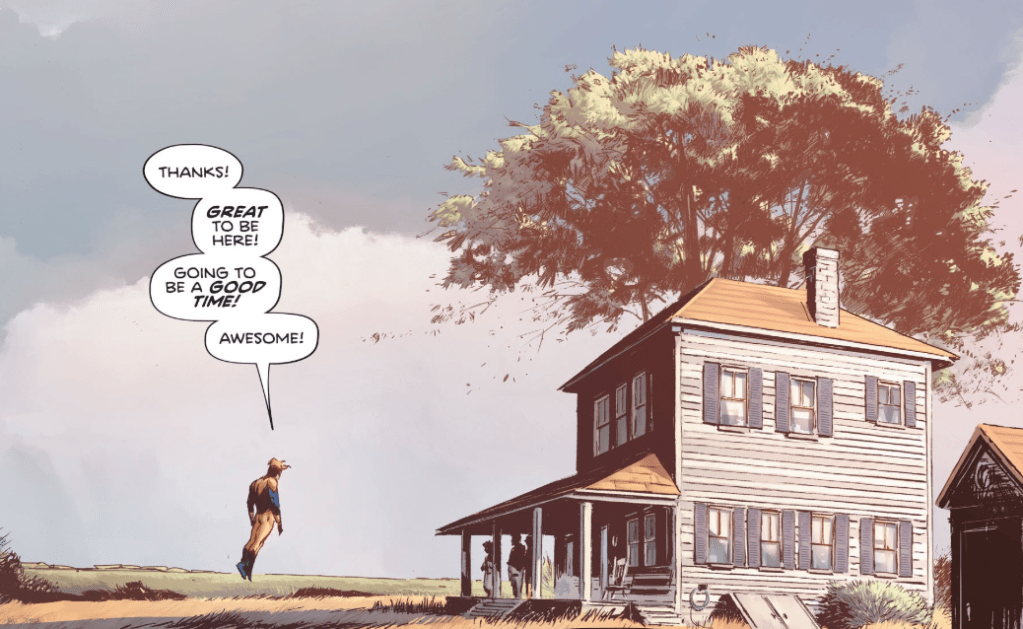
With the scene set, we can look a bit deeper into why the story did, and why it did not, work.
Firstly though, the artwork is fantastic. Clay Mann’s and Morey’s work together in many places throughout the nine issues is beautiful and it has been commended as such. There is some lovely panel layouts and the artwork is vibrant and crisp throughout. Artwork goes a long way in selling a story and with perhaps less stellar artists, the backlash could have been greater.
The story however has many issues, but the emotional offloading is mixed. Heroes would speak to Sanctuary, a computer system designed by Batman that automatically deletes everything it records. It provides some of the best bits of the series, highlighting lesser-used characters and their personal struggles. This is a great way of showing the pressures on the heroes and promoting better mental health. However, a handful of the perspectives shown feel a bit out of character or forced as a joke, which then undermines any positive message King might have been trying to get across, as it trivialises some of those characters’ problems. Generally though, these interviews to camera work, fitting into the concept of Sanctuary and the story.
As mentioned, to protect the heroes, Batman made sure that none of the information is kept, to safeguard secrets and potential weaknesses that villains could exploit if they ever fell into the wrong hands. This is a very sensible idea, however common sense would suggest having a system designed which does not record their interviews at all, no matter how briefly.
Unsurprisingly then, Batman’s super therapy computer is compromised and videos of heroes talking to the camera are leaked. They are leaked to Lois Lane who, after sitting in them for a few days, makes the story public. Whilst this pushes the story along, this seems like a betrayal of character not only for Lois but Superman too who doesn’t talk her out of it.
This leads to people rightly fearing the heroes, as you would not want to learn that beings with immense power might be having a mental health crisis. We get a great, long monologue from Superman, weirdly introduced as a brief statement from the hero community, highlighting the scars brought about from putting your life on the line constantly. Whatever qualms there are about the story, the dialogue here is not one of them.

There is though, that fight between Harley and the Trinity. It stirs up memories of the time Deathstroke took on the whole Justice League in Identity Crisis. Sure, Harley stealing the Lasso of Truth to then force Batman into revealing where he kept kryptonite was creative and even had the payoff from a joke as Bruce had denied keeping any kryptonite on him moments ago. It still feels jarring though, given the disparity in power, experience, and speed between them. However, most comic fights are silly when you think about it, so it is easy to give this one a pass.
The main issue with the story though, centres around Wally West. It turns out Wally was responsible for the deaths of the heroes, as he had had a mental breakdown and accidentally released a deadly burst of speed force, killing those around him.
There are clues to Wally’s mental instability hinted at through the issues. In his interviews with Sanctuary, he’s making little if any progress in his time there, speaking about the losing Barry, Jal and Linda. He then decides for some reason to crack Batman’s system for protecting the interviews of heroes, piecing together a puzzle that should take a billion years in a few seconds. With this, he accesses the records of all who has passed through sanctuary and for a moment doesn’t feel alone.
Instead of feeling solace that he is not alone, Wally becomes overwhelmed. The overload of information causing him to crack and lose control, the speed force launching out of his body as the others fatally choose to come to his aid. He decides to use Sanctuary to create fake realities where Harley and Booster see each other killing the heroes. He then disappears five minutes into the future to kill that version of him, bringing the body back to leave at the scene.
It is that scenario which is at the heart of the issues with the story. The whole plot was setup as a murder mystery, so like most murder mysteries, there is an information dump right at the end revealing Wally as the killer and what had actually happened. What it lacked, though was a motive, which normally makes murder mysteries have a satisfying payoff. Instead, the motive is replaced with Wally’s breakdown and loss of control instead, which is far less interesting. It gives it another similarity to Identity Crisis where the motive was Jean just being mad.
Obviously, whenever someone can time travel, the question should always be ‘why didn’t they go back in time to fix things?’ King actually covers this in the story as Wally was worried he would do a Barry and accidentally cause another flashpoint.
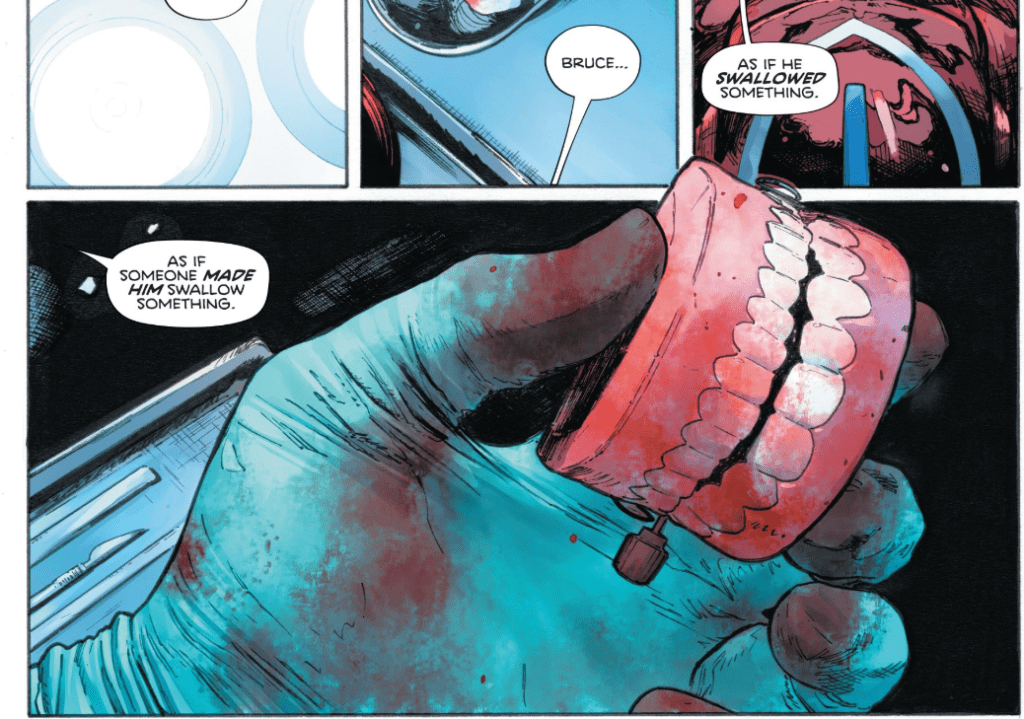
With Wally as the killer, there are two immediate questions that jump out. Firstly, who was sending the videos to Lois? Now it could only have been Wally, so why did he do it? What could possibly have been the motive behind doing so? And secondly, why were there a set of toy teeth in Commander Steel’s oesophagus? Did Wally shove his hand down Steel’s throat purely to try and frame Harley? That seems incredibly dark.
Why even try and frame Harley and Booster? Wally could have made Sanctuary show them all the same thing where someone else, literally anyone else – Killer Croc, Sinestro, Jean Loring, anyone else – killed the heroes. He was apparently only framing them to buy himself time to then confess via video. For the fastest man alive, stalling seems unnecessary to say the least.
Another loose end is that Barry Allen is adamant that Booster killed the other heroes, supposedly finding evidence that Booster was responsible. We never find out what this evidence is.
Anyway, it all gets neatly tied up with future Wally and current Wally, as Booster puts it, completing the loop. With the current Flash, doing whatever the future or old one did with a younger Flash. And so on. Ad infinitum. Plus, they just go to the future to grab a clone of Flash to be the body, which doesn’t sound very ethical. Either way, everyone loves the use of time travel and clones in comics.
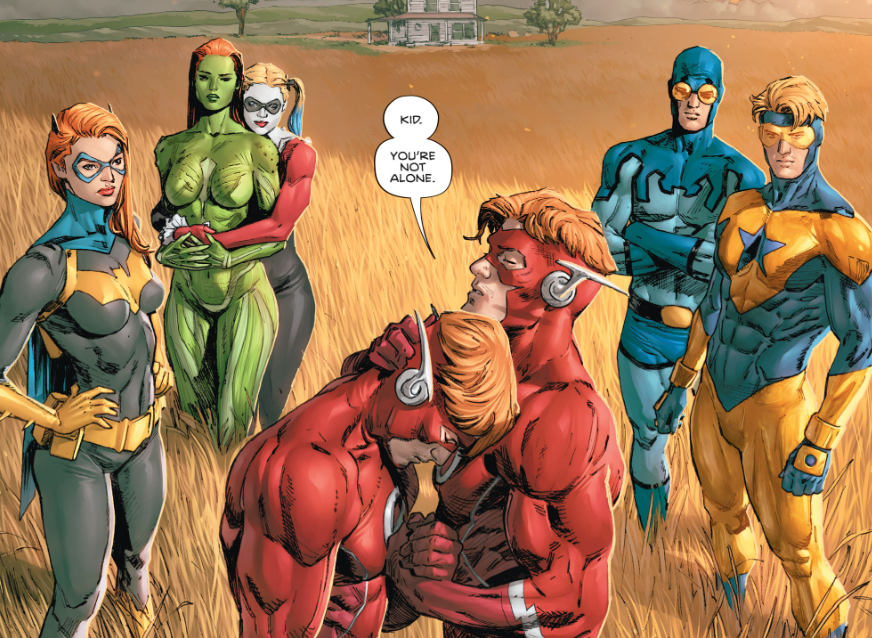
Booster, Harley, Poison Ivy and Blue Beetle all decide to help keep Wally’s secret before Batman, Superman and Wonder Woman turn up to chuck him behind bars. Both of which seems absurd. Were the former happy to help cover up the ordeal – bros before heroes as Booster puts it? This seems problematic if you see the heroes as something akin to a police force. Given the political climate at the time, it is a surprise this got through.
Worse though, was that the Trinity just locked Wally up. This whole story was supposed to be about mental health. If Wally was having a mental health crisis, then surely his level of accountability was diminished? Was there no alternative that sees a better outcome for Wally despite of his actions – like maybe seeing professional help rather than being behind lock and key?
Now, not all of the blame sits with Tom King. In an interview with CBR, he explains editorial told him the story had to include Wally, Harley, and Booster. King, whilst quite protective of the story, wishes it had not included Wally. In fairness, that’s where a lot of the issues come from, and it certainly received a lot of backlash from fans who did not want Wally treated that way.
What King could have worked on was coming up with a legitimate reason why Wally would cover it up and the reaction from his fellow heroes. No doubt he may have written himself into a corner, by having a hero as the killer.
In true comic book tradition, if something is controversial it must be retconned. In Flash #761, Reverse Flash admits to Barry that he was the one who manipulated Wally into covering it up. The Flash 2021 Annual then reveals that it was Savitar who caused the surge in speed force energy, not Wally, killing the heroes. Then finally, in Flash #795 and #796, we find out that none of the heroes died and had instead been replaced with clones from the 35th century.
In the end, it feels rushed, at least in the writing. There are enough interesting plot points and ideas to make a fantastic book, however they just do not seem to connect as they should.
Buy Heroes in Crisis [I earn a commission] – Forbidden Planet UK



 Key Comics Vault
Leave a comment